Bitcoin Slide Wipes Out Over $400 Million in Crypto Longs: Reset or Warning?
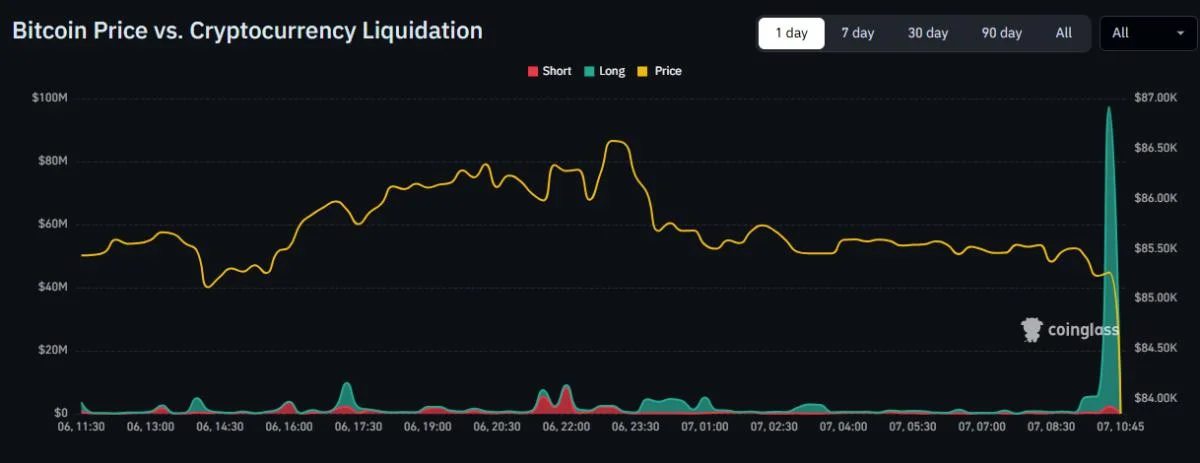
Exchanges liquidated $403.58 million in leveraged crypto longs within one hour as Bitcoin slid to about $83,800. That equals about 0.27% of open interest, the total value of unsettled futures contracts.Longs made up 97% of the $415.33 million total, so the flush hit one side of the market. However, it cleared only a small fraction of the leverage still outstanding.How Much Leverage Did the Flush Clear?The selling arrived in one burst. CoinGlass, a derivatives data tracker, logged 98% of the $412.99 million in four-hour long liquidations inside the final hour.Over 24 hours, longs made up $487.02 million of $554.76 million in liquidations. That hour alone holds about 83% of the day’s long total.By comparison, the 10th-largest event on CoinGlass’s all-time list reached $2.77 billion, about five times the 24-hour total.Ethereum longs accounted for $155.12 million, ahead of Bitcoin’s $115.73 million, even though Bitcoin is the larger market. That gap may reflect sharper ETH losses, heavier leverage, or both.CoinGlass’s header put open interest at $150.24 billion, down 2.45%. Because open interest is dollar-denominated, falling prices alone can account for part of that drop.Reset or Warning? Where the Data SplitsCommentators on X split on the read. A few argued that the speed of the selloff points to positioning. “$400M getting cleaned out that fast says positioning was part of the move, not just a sudden change in Bitcoin’s long-term case.” “Natural part of the cycle. Flush out the over leveraged longs, attract new long positions and move back up.” The data supports parts of both views. The one-sided, single-hour burst fits a positioning flush, while the $150.24 billion in open interest suggests most leverage survived.Meanwhile, wallets holding 100 to 1,000 BTC added 113,950 BTC between mid-July and late September, showed.Open interest of $150.24 billion means another forced-selling burst remains possible. Spot buying, which has no forced sellers, could decide whether steadies or the next flush follows.