Coinbase’s x402 Records 138.5M Transactions: Chainalysis Shows AI Agents Reshaping Crypto Payments
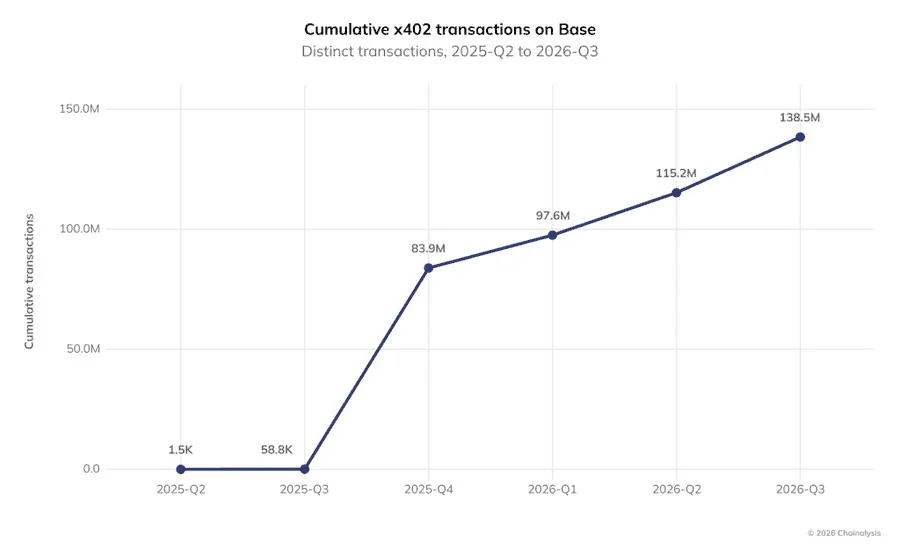
According to blockchain analytics firm Chainalysis, activity has expanded sharply since the protocol’s early stages, as autonomous AI agents increasingly use digital assets to pay for online services.The findings, published in Chainalysis’ October 14 report, North America: Inside the Growth of Agentic Commerce, point to an emerging use case for stablecoins and blockchain infrastructure. Rather than relying exclusively on conventional payment systems, AI agents can use crypto to settle small charges for data, application programming interfaces (APIs), and other digital services.The US is leading the AI on-chain economyThe United States is emerging as a key center for the development of on-chain payments involving autonomous AI agents. Chainalysis identified Coinbase, which developed x402, and Circle, the issuer of the USDC stablecoin, as important companies supporting this activity.Chainalysis data shows explosive growth in Base’s x402 activity, with cumulative distinct transactions by AI agents rising from 58,800 in Q3 2025 to 138.5 million in Q3 2026. Source: Chainalysis via XThe report recorded a sharp increase in x402 transactions on Base, an Ethereum layer-2 network associated with Coinbase. Cumulative activity rose from approximately 58,800 transactions in the third quarter of 2025 to 138.5 million by the third quarter of 2026. The figures indicate that the payment protocol has moved well beyond its initial scale, although transaction counts alone do not establish how much economic value the activity represents.The underlying model, known as agentic commerce, allows AI agents to initiate and execute payments for specific tasks without requiring a person to authorize every individual transaction. For example, an agent retrieving information from a paid API could send a small payment for each request rather than depend on a conventional subscription or manually approved purchase.Stablecoins are central to this approach because they can transfer dollar-denominated value over blockchain networks at relatively low cost. USDC is one of the digital currencies used in this developing payment ecosystem. Coinbase’s x402 infrastructure provides a mechanism for connecting payment requests with blockchain-based settlement, allowing software to pay for services programmatically.The trend also has the attention of established financial institutions. Will Su, BlackRock’s head of digital assets research, told Chainalysis that the firm was watching agentic commerce closely, noting that AI agents could create “meaningful demand for frequent, low-value payments around the clock.”AI agents drove XRP Ledger transaction growth, with daily settlements exceeding 600,000 in late September and early October 2026, peaking near 700,000, according to t54.ai data. Source: @BSCNews via XThe broader North American crypto market remains substantial despite a slowdown during the reporting period. Chainalysis estimated that the combined crypto economies of the United States and Canada reached $3.02 trillion in the 12 months ending July 1, 2026, down 1.9% from the preceding period. The US accounted for $2.78 trillion, a 2.2% decline, while Canada’s crypto economy grew 2.3%.Hoolie Tejwani, head of Coinbase Ventures, attributed part of the industry's development to a shift from infrastructure building toward practical applications. “A lot of what we’re seeing vs. 2025 comes down to maturation of the industry,” Tejwani said. He added that earlier investments were becoming “products with real users, liquidity, and markets in 2026.”AI payments are becoming stickierChainalysis also found signs that x402 users are returning to the system after their initial funds run out, suggesting that activity is becoming more sustained. Among wallets that made payments on at least two separate days, the share receiving a second funding within 30 days increased from 70.6% for wallets first funded in the third quarter of 2025 to 89.3% for those first funded in the second quarter of 2026.The figures suggest that more participants are replenishing their balances to continue using the payment system instead of treating it as a one-time experiment. However, wallet refilling is an indicator of continued use, not direct proof of commercial profitability or widespread adoption among businesses.Coinbase’s x402 enables AI agents to make low-cost crypto payments, with 87% of transactions below $0.10 by September 2026, supported by low-fee stablecoin settlements. Source: Chainalysis via XAnother measure points to more deliberate participation. In late 2025, the median wallet waited 73 days between its initial funding and its first x402 payment. By the third quarter of 2026, that interval had fallen to just 18 minutes, according to Chainalysis. The shorter gap suggests that newer wallets are increasingly being funded specifically to make payments through the protocol.The size of those AI agents' payments helps explain the potential appeal of blockchain-based settlement. Chainalysis reported that more than 87% of x402 payments during its extended review period, which ended in September 2026, were worth between one-hundredth of a cent and 10 cents. The most common payment range was between one and 10 cents.AI agents are increasingly making small, frequent payments for services such as code reviews, financial intelligence, data access, and API calls, supporting the growth of agentic commerce. Source: @chainalysis via XSuch transactions are difficult to support economically through conventional card networks, where processing costs can make very small purchases impractical. Blockchain transfers using stablecoins can settle for fractions of a cent under suitable network conditions, making pay-per-request services more feasible. Actual costs vary according to network fees and transaction conditions.Circle described the distinction between payment methods as “card rails for consumer-prompted agent payments and stablecoin rails for machine-to-machine settlements that are too small for card economics.”That division suggests that AI agents' payments may complement existing financial infrastructure rather than immediately replace it. Card networks can continue to handle purchases initiated by consumers, while stablecoin payments may serve automated transactions between software systems.For now, Chainalysis characterizes agentic commerce as an emerging market still in an experimentation phase. The rise in transactions driven by AI agents, increased wallet replenishment, and shorter time to first payment provide evidence of growing engagement with x402. Whether that activity develops into a durable will depend on practical demand, payment reliability, , regulatory clarity, and the ability of businesses to turn automated transactions into sustainable services.