PNC and Coinbase Launch USDC Payments Pilot: What Changes for Businesses?
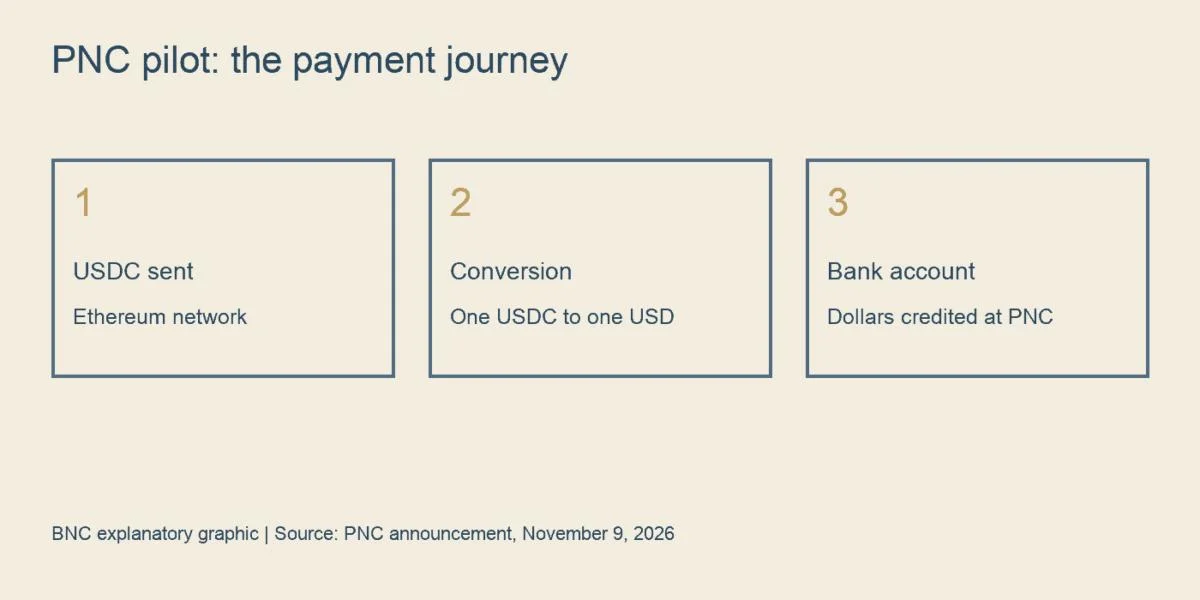
PNC’s USDC payments pilot offers a practical version of crypto adoption: a business can receive a stablecoin payment and end up with dollars in its existing bank account. The blockchain sits inside the payment journey, while the recipient’s final balance looks familiar.The bank announced the service on November 9 for eligible corporate and institutional clients, using Coinbase payment infrastructure. Incoming USDC on Ethereum is converted one-for-one into dollars and deposited into a designated PNC account. Access is initially limited to a pilot, rather than a universal launch for every customer.That narrower scope is the story’s most useful detail. The service tests whether stablecoin infrastructure can improve business payments without requiring the recipient to keep its working capital in tokens.What the PNC USDC payments pilot doesAt a simplified level, there are three stages: a sender makes a USDC payment, the payment infrastructure handles conversion, and the eligible recipient receives dollars through PNC. The bank presents the service as a way to improve access to funds and cross-border payment efficiency.“Our clients are continually looking at new ways to interact and transact with customers, suppliers and business partners,” said Tom Lang, PNC’s treasury management product and operations head, in the announcement.That is the proposition being tested. It does not establish that every participating business will save money or receive immediately spendable funds at precisely the moment an Ethereum transaction confirms.Why automatic conversion mattersFor a finance team, receiving a payment is only part of the job. The receipt must match an invoice, appear correctly in the accounts and become usable for payroll, suppliers or other commitments. A service that ends in a bank balance may reduce some of the operational change needed to accept a new payment method.Consider a hypothetical exporter with a customer that already holds digital dollars. The customer could prefer sending USDC, while the exporter could prefer receiving ordinary dollars. Automatic conversion connects those preferences without assuming that both sides want the same treasury strategy.The example is illustrative, not a customer case disclosed by PNC. Its appeal depends on details such as pricing, supported payment corridors and the recipient’s existing alternatives. A new route is useful when it solves an actual problem, not simply because a blockchain appears somewhere in the process.Fast blockchain transfers are only one layerCircle, USDC’s issuer, describes USDC as a dollar-redeemable stablecoin supported by cash and cash-equivalent reserves. It promotes the token for around-the-clock transfers and settlement. Those properties help explain why payment companies are interested in stablecoins as a transport mechanism.But the entire customer experience includes more than token movement. Businesses must also consider when conversion occurs, when their account is credited and when those funds can be used. A fast transaction on one layer does not automatically answer every question about the full payment journey.This distinction is especially important for cross-border comparisons. A useful assessment would compare the total cost, timing and reliability of the pilot with a business’s actual alternatives for a specific corridor. Comparing a blockchain’s technical speed with the slowest imaginable bank transfer would tell a much less useful story.What businesses still need to askPNC’s public announcement does not provide a detailed fee schedule, guaranteed end-to-end settlement time, list of supported international corridors or date for broad availability. Those gaps should be treated as unanswered commercial questions rather than filled with assumptions.A potential participant would want to know who can send, which network and token formats are accepted, and how a payment is identified and reconciled. It would also need clear procedures for incorrect transfers, delayed receipts and support outside normal business hours.These are evaluation questions, not claims that the pilot lacks such arrangements. Limited pilots often exist precisely to establish which features customers value and which processes need refinement before a wider rollout.Adoption without a new investment thesisThe pilot is a payments development. It does not by itself demonstrate a reason for Ethereum’s price to rise, guarantee additional Coinbase earnings of a particular size or establish how much USDC volume PNC will generate.Those outcomes depend on adoption, transaction economics and how the service scales. Separating usage from token-price speculation makes the story more valuable: a payment product can be commercially useful even when it produces no immediate market rally.BNC’s coverage of describes another way digital dollars are entering familiar interfaces. PNC’s experiment applies that broad theme to business receipts, with a different customer group and a different endpoint.The test is whether customers keep using itThe most revealing next disclosures would be evidence of repeat business use, wider eligibility and clearer information about costs and availability. Transaction announcements can show that a connection works; sustained use would show that customers find it preferable for some real payment needs.For banks, the experiment raises a strategic question: can they incorporate new settlement technology while keeping the deposit relationship and the customer experience? For crypto infrastructure providers, it tests whether their technology can operate usefully behind the scenes.PNC’s pilot gives that question a concrete form. A stablecoin comes in, dollars reach the business account, and the recipient can judge the result on familiar terms: cost, speed, reliability and ease of reconciliation. Those measures will matter more than the novelty of the route.