Quant Price Struggles to Recover as Selling Pressure Persists – Can QNT Reach $200?
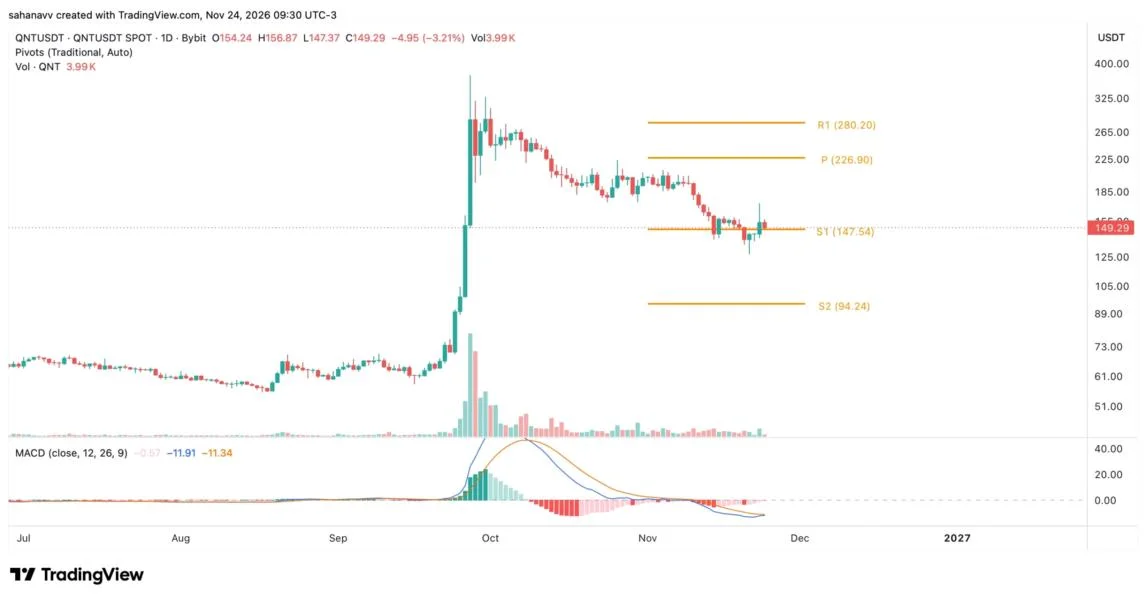
The Quant price is struggling to rebound after a sharp September rally, which attracted strong bearish attention, resulting in a huge correction. The token, which briefly climbed above $350, has since surrendered a significant portion of those gains and is now approaching a crucial support region around $147. With the broader price structure remaining weak, buyers face an important test as the token attempts to stabilise near its recent lows.However, the latest market activity raises questions about whether QNT is nearing a potential turning point or whether the ongoing correction has further room to run. A closer look at its price structure and market positioning could offer clues about where the token is headed next.QNT Price Approaches a Key Support After 57% PlungeQNT’s daily chart shows a sharp reversal following its September rally. After spending much of July and August trading between $55 and $70, the token witnessed a sudden surge in late September, climbing above $350 before losing momentum. The rally failed to sustain its gains, and QNT gradually entered a downward trend, forming lower highs and lower lows throughout October and November.The MACD line indicates that bearish momentum continues to dominate. However, the negative histogram is relatively small compared with the earlier stages of the decline, suggesting that selling momentum may be easing. A bullish crossover could provide an early indication of improving momentum, but until then, the broader technical outlook remains bearish.The latest decline has brought the token close to the $147.54 support level, marked as S1 on the daily pivot indicator. If QNT fails to hold above this range, the next major pivot support sits considerably lower at $94.24. On the upside, the pivot level at $226.90 could act as a broader recovery hurdle, although the token would first need to establish a stronger upward structure.Open Interest Falls Sharply as Spot and Futures Selling Pressure PersistsQNT’s derivatives data reveal a significant shift in market participation since its September rally. Aggregated open interest, which surged to nearly $80 million during the rally, has since declined steadily to approximately $24.88 million as of November 24. This represents a substantial reduction in outstanding futures positions, suggesting that speculative participation has cooled considerably as the token’s price continued to fall.The funding rate also remains slightly negative at -0.0002, indicating a modest bearish bias in perpetual futures positioning, with short positions paying long positions. However, the more interesting signal comes from the cumulative volume delta (CVD) across spot and futures markets.Aggregated futures CVD has fallen to approximately -642.93K, while spot CVD stands near -263.1K. Both indicators have trended lower since the September rally, suggesting that aggressive selling has continued to outweigh aggressive buying across both markets. The simultaneous decline in open interest and negative CVD presents a cautious picture for QNT.While falling open interest points to traders closing positions and reduced speculative activity, the negative CVD readings suggest that buyers have yet to regain control of market orders. The spot CVD trend is particularly worth watching, as it indicates that selling pressure is also visible outside leveraged futures trading.Conclusion: Can QNT Reclaim $150 and Reach $200 Before November Ends?QNT’s ability to reclaim $150 will be the first indication of whether buyers are returning after the prolonged correction. The declining open interest and negative CVD across spot and futures markets make such a rapid recovery more challenging. Although the MACD suggests that bearish momentum may be easing, buyers still need to demonstrate stronger conviction.With the token trading near $149, a move above this psychological level appears within reach, provided buyers manage to defend the $147 support region and improve spot buying activity. However, reaching $200 before the end of November would require a much stronger recovery, representing an upside of approximately 34% from current levels.