Standard Chartered pushes $2 trillion stablecoin market forecast to 2030 as supply growth stalls
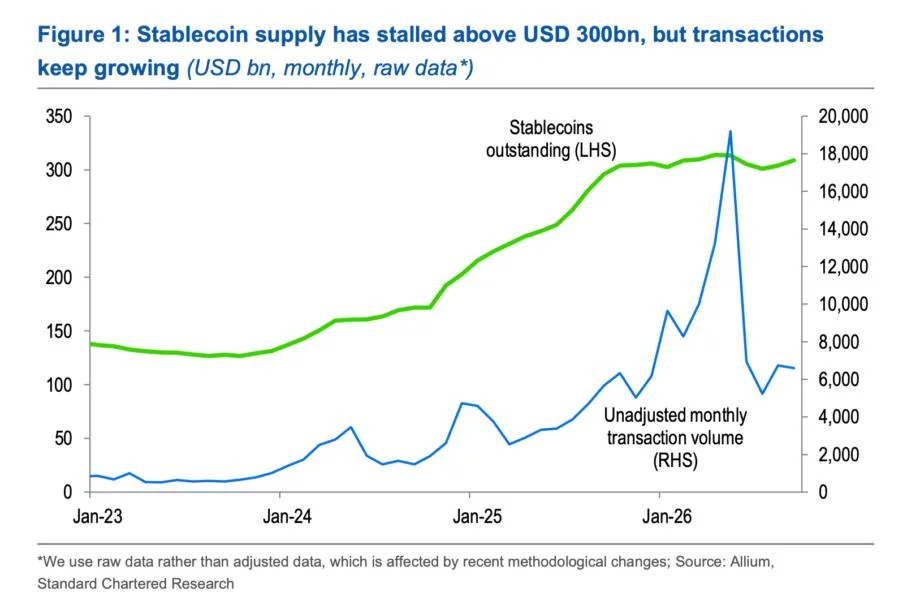
Standard Chartered Bank has pushed its stablecoin market forecast to $2 trillion by 2030, up from 2028, after supply growth stalled this year.The bank is keeping its $2 trillion estimate, but now expects the market to take two years longer to reach it, Geoffrey Kendrick, Standard Chartered's global head of digital assets research, said in a Wednesday report.Stablecoin supply has remained between $300 billion and $320 billion over the past 12 months and currently stands at around $309 billion, Kendrick said. He views the slowdown as cyclical rather than structural because it has come during weak crypto market activity.Past periods of flat or falling stablecoin supply were followed by renewed growth after crypto markets recovered, Kendrick noted.'Usage is still growing'While stablecoin supply growth has stalled, usage or transaction activity has continued to increase, Kendrick said, noting raw onchain transfer value reached a monthly record of $19 trillion in May. Monthly volume has averaged just under $10 trillion so far this year, up from $4 trillion in 2025, he added.Meanwhile, average monthly stablecoin velocity, which measures how many times each dollar stablecoin changes hands, has doubled to around 30 times this year from 15 times in 2025, Kendrick said.USDT's monthly velocity has stayed near seven times. USDC's velocity, meanwhile, increased to around 80 times this year from 45 times in 2025.Kendrick said the difference comes from how the two stablecoins are used. USDT is mainly used for dollar savings in emerging markets, while USDC is used more for payments, financial transactions, and early payments between AI agents.Kendrick expects the most competition in stablecoin payments and transactions in developed markets. He said potential challengers include Open USD (OUSD) [similar to Global Dollar Network (USDG)], stablecoin infrastructure provider M^0, and A+, a planned network that would allow banks to issue a shared stablecoin and keep the income from its reserves. "It is the DM transactions/TradFi replacement sector which we see as the most contested going forward," Kendrick told The Block. "I highlight a number of challengers that compete at the margin - USDG for venues, M^0 as longer-run infrastructure, and the multi-bank network model (A+) for banks outside the incumbents' existing yield-share terms. Issues like yield capture will ultimately determine how this sector plays out."Regulation remains a riskKendrick said regulation is a major risk to his $2 trillion forecast, noting that much will depend on whether other countries adopt rules similar to the U.S. GENIUS Act and how those rules affect stablecoin use."The main threat to USDT's EM [emerging market] dominance would be if global regulators were to closely follow the lead of the U.S. GENIUS Act," Kendrick also noted.The GENIUS Act is due to take effect in January 2027. Kendrick said the implementation of those rules could create more competition from bank-backed and multi-issuer stablecoins.The Funding newsletter: Stay on top of the latest crypto VC funding and M&A deals, news, and trends with my free bi-monthly newsletter, The Funding. Sign up here!