US Savings Rate Hits a 2022 Low: Could Bitcoin Be a Hedge?
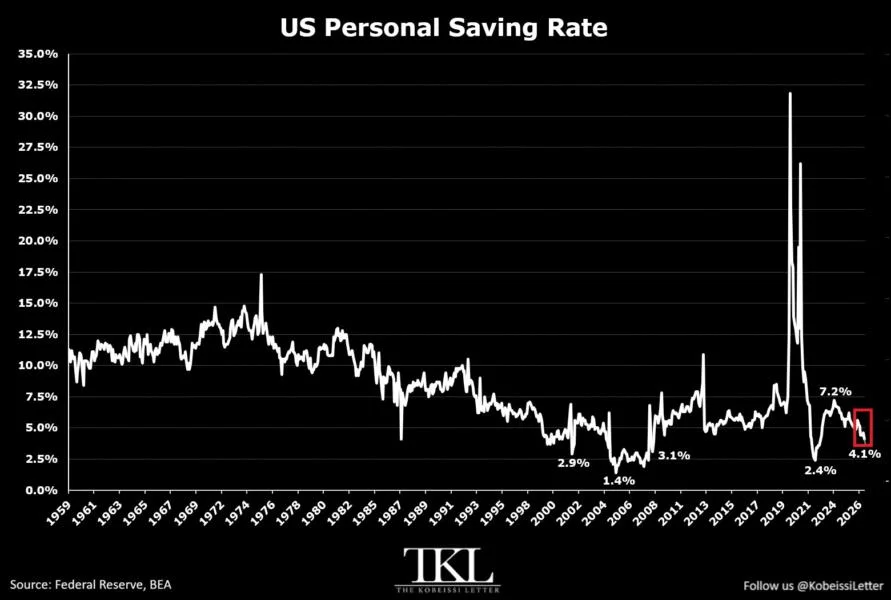
The United States personal savings rate dropped to 4.1% in August 2026, its lowest level since November 2022, according to the Bureau of Economic Analysis.That decline now raises a pointed question: can Bitcoin serve as a hedge against shrinking household buffers?What Does the Falling US Savings Rate Reveal About Household Finances?The personal savings rate measures the share of disposable income households set aside rather than spend. A falling rate signals families are draining reserves to maintain consumption levels.August’s reading fell 0.5% from July. It has dropped 1.6 points since January 2025, based on Bureau of Economic Analysis data.Excluding the 2022 inflation shock, this marks the lowest level since 2008. The five-year average now sits at 5.4%, the weakest in 14 years. That compares with roughly 6% before the pandemic. Persistent inflation in housing, food, and energy continues to squeeze household budgets nationwide.Follow us on X to get the latest news as it happensSpending remains relatively resilient for now, but that strength comes at a cost. Families increasingly rely on savings as their main cushion shrinks month after month.For most Americans, this level means less room to absorb a job loss, a medical bill, or any other emergency expense. It leaves fewer households prepared for financial shocks heading into next year.Could Bitcoin Work as a Hedge Against This Pressure?Bitcoin just posted its first fully green third quarter on record. It gained 42.71% as Even so, BTC still roughly 4% below its $87,498 starting price for 2026. It also remains about 34% below its record near $126,000.That mixed picture complicates the hedge narrative. Fidelity’s Jurrien Timmer recently highlighted Bitcoin as a key portfolio diversifier beyond traditional stocks and bonds, alongside gold and commodities, as correlations between equities and bonds turn unusually positive.Bitcoin remains volatile and often tracks technology stocks during risk-off periods. When households cut back on savings, demand for speculative assets can weaken too, at least in the short term. Regulatory and access barriers still limit its use as a true inflation hedge.This savings decline signals broader financial fragility across much of the population. Bitcoin is not an automatic solution for struggling households, though it may fit within a diversified strategy for long-term investors.Subscribe to our YouTube channel to watch leaders and journalists provide expert insights